
Why You Are Miserable
Finding Freedom from the Ego's Shackles: A Guide for the Ambitious Yet Unfulfilled

Lately, I've been on a journey to understand myself better, diving deep into the workings of my ego. From my early days in school, I was always driven, chasing after achievements like top scores and prestigious jobs. Each success felt like a rush of fireworks in my brain.
I was miserable on the inside.
I was a driven kid since school and for the driven and ambitious among us, there's nothing quite like the thrill of achievement. It was always about getting the top scores, landing a prestigious job, getting promoted - each accomplishment lighting up my brain's reward centers like a kaleidoscope of fireworks.
I realized that back in 8th grade, my scores started to tarnish and dip hard. I never found the answer to that until a few weeks ago. This was comprised of majorly three reasons.
I'd always been a quick learner, but suddenly, my intellect wasn't enough to guarantee top marks and I had to put “Effort”.
Second, puberty hit, and my hormones were all over the place, leaving me feeling lost.
My Ego.
Let’s talk about the ego
The Ego Trap
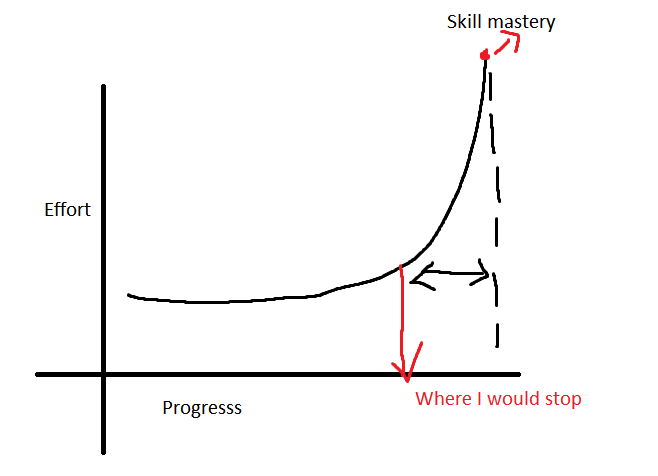
The root issue, as ancient wisdom traditions have long revealed, is that the ego is an entity without a permanent home. It endlessly shape-shifts, hungry for the next pleasurable experience or attainment to latch onto and identify with, if only fleetingly.
The above graph describes the way I would work towards things.
If I were to learn coding again the way I was in college from scratch today and it was not the skill that feeds me, this is the way it would go. I'd dive into the basics with enthusiasm, feeling confident as I progressed.
But when faced with a daunting project requiring intense effort, that's when my old habits might resurface. Suddenly, the excitement fades, and I find myself making excuses like "This isn't fun anymore" or "I'm just not feeling it." It's a familiar dance of self-sabotage, where my ego shields itself from the possibility of failure. So I would immediately hop to the next “easy” achievement I could get.
Many of us find ourselves in a similar struggle. Imagine someone who excels in their job, earning a comfortable six-figure salary with seemingly little effort. But despite outer "success", this person remains inwardly restless, quitting when he can no longer use the job to feel superior and admired compared to others. The ego's fix of self-worth through status and achievement runs dry.
How can someone so successful be miserable?
This is the paradox of the modern achievement treadmill laid bare. No matter how "high" we climb, the ego always lurks, ready to convince us that true satisfaction lies just past the next summit.
The Ego's Evolutionary Roots
Dr. Alok from healthygamergg explains, 'Ego has survival utility but not happiness utility.'
The ego is a universal experience of all human beings. Why is that? Because the ego has been selected for by evolution - it's what helps us survive...we've evolved to survive, not be happy.
So what do you think happens when you use ego as an instrument for happiness?
Our drive for advancement is deeply rooted in our biology, pushing us to constantly learn and grow. This can be beneficial, motivating us to seek new challenges and opportunities. However, unchecked can lead to restlessness and a constant chase for the next "high."
For example, feeling bored at work for a short period might trigger the urge to quit and find something new. Similarly, facing difficulties in a relationship might make us crave the initial excitement of a new connection.

It's important to understand that these urges are driven by the ego's desire for immediate gratification, not by a genuine search for long-term happiness. While our ancestors' ambition helped them survive, learning to manage this drive is key to thriving in today's world.
Whose Voice Are You Listening To?
If we take an honest look, virtually all of our driven ambition and fixation on accomplishments stems from a deep-seated fear - the fear of simply being ourselves, as we are right now in this moment, and somehow falling devastatingly short.
I have these thoughts interrupting me a lot. “ I did not perform well enough at work”. “I could have still got those last 3 marks in that exam”. “I would have gotten my Master’s admits if I had tried more”. → This is the survival mechanism inside the ego. The ego always wants more, it craves more.
“I think my ego is great, it keeps me going forward” (but are you happy?)
“Look at Sharmaji ka beta, he is earning 50L and is married already, what about you?”
Or the more common that I have seen amongst my peers and one that I am at fault as well → “Look at him in the US, enjoying his life, living the dream”.
It's the ego's tormenting voice that whispers "You're not _____ enough" and uses hyper-comparison to convince us that our worth and identity depends on achieving some lofty future ideal, all the while devaluing the beauty and opportunity of what's here.

As the Stoic philosopher Seneca cautioned: "There are two ways to avoid fear - that of a coward and that of a sage. The coward flees challenges altogether, burrowing into a life of trifling comforts. While the sage recognizes the futility of evading fear, focusing rather on judging existence not by transient circumstances but by the enduring truth at its source."
The Path of Vairagya
In the yogic philosophy of Patanjali, the antidote to the egoic state is "vairagya" - the practice of non-attachment, detachment or dispassion. I am not saying “run away” from every thing or detach from everything. Practicing detachment is to look at all experiences with equanimity, without grasping or aversion.
Work: "This presentation is important, but my self-worth isn't tied to its outcome."
Relationships: "I care deeply for my partner, but I understand they won't always fulfill all my needs."
Failure: "This setback is frustrating, but it doesn't define me."
Material Possessions: "I enjoy this new gadget, but it won't bring lasting joy."
Outcomes: "I'll give my best effort, but I accept what life throws my way.
“This feels like such a drag. I want my material possessions, I want to live the comfortable life, I want the big house, the swimming pool” → If you just thought that, that is your ego.
So we work hard but don't confuse our self-worth with the temporary results. We foster ambition, while staying unattached to arbitrary milestones like being "the best" compared to others.

But this is easier said than done. The ego is an amazing utility that knows exactly when to strike, it knows exactly when to pull you down and when to shoot you to the sky. The key is to notice it and not let it hinder your progress.
The Practice for Modern Life
Of course, fully stabilizing in this liberated view is the work of lifetimes. We can't simply quit careers and relationships overnight to join an ashram.
Transcending the ego entirely can take decades of sustained spiritual practice and is not a realistic short-term goal for most.
“If it is going to take so long and if it is so hard, why bother doing it” → if you just thought that, that is your ego. The ego making its way to make sure that it is always king.
As Marcus Aurelius advised, the key then is to "practice going away" from the ego frequently in life, through meditation, prayer, philosophy, and other contemplative acts.
We intentionally take "spiritual breaks" from reflexively slipping into egoic states by reminding ourselves of the non-dual perspective - that no amount of success, pleasure or external attainment can ever fill the bottomless pit of the ego.
We ask ourselves: "If I accomplished my current driving goal, would I truly be fulfilled and done wanting more? Or is this just another passing desire projected by thought?"
At the same time, we embrace ambition, achievement and growth not as frantic grasping, but as a joyful expression and expansion of our innate potential. The path is one of paradox - effortless effort, intense yet undisturbed by results.
The Path Forward
Some will choose society's model of aggressive ego-achievement as their life's sole motive. And that's a valid path, though its pitfalls of alienation, emptiness and lack of fulfillment are well-known.
And some will renounce all traditional pursuits for the monastic, contemplative life. An equally legitimate calling for some.
But for many of us in the "grey zone" - those who enjoy the thrill of ambition and manifestation, yet also yearn for something more meaningful and lasting - the difficult but most integrative path is to participate in the ego-driven world while noticing when it is the ego, and when it is “YOU”.
My current focus is cultivating a balanced space within myself. This involves acknowledging the ego's influence while simultaneously nurturing my sense of purpose. It's a challenging journey, as Dr. K perfectly illustrates: "Imagine tending a beautiful garden that fosters your growth. Then, the ego swoops in and wreaks havoc."
The key is to find a happy coexistence between the ego and the sense of self. Both elements play a role in our evolution. Ideally, this balance will lead to a more creative and impactful life, a stark contrast to the Sisyphean struggle of constantly pushing the ego's boulder uphill, only to face inevitable setbacks.
Here are some ways I am planning to improve and understand myself better:
Making meditation a non-negotiable ritual to frequently come back to the still point within beyond all thought imaginations and identities
Catching ourselves whenever unhappiness or agitation stems from ego comparisons and reframing our attitude
Embracing core values like gratitude, humility, and a "healthy disinterest" in external praise/criticism
Exploring luminary teachings and stories that reveal our true nature beyond the ego
Building communities of like-minded people committed to living with authentic purpose
Facing our deepest existential fears through self-inquiry, rather than running from them into achievements
In sharing my journey with you, I hope to shed some light on the intricate dance we all have with our egos.
It's through stories and shared experiences that we learn and grow together. So I invite you to reflect on your own relationship with your ego and how it influences your thoughts and actions.
Feel free to share your thoughts in the comments below – your insights could inspire others on their own journey of self-discovery.
This entire newsletter’s credit goes to Dr.K from healthygamergg. Please find the resources and links below.
Thank you for being a part of this journey.
Resources
Understanding the Ego and Self-Awareness:
Books:
"Ego is the Enemy" by Ryan Holiday
"Stumbling on Happiness" by Daniel Gilbert
"Wherever You Go, There You Are" by Jon Kabat-Zinn (https://www.amazon.com/Wherever-You-There-Are-Mindfulness/dp/1562827693)
"10% Happier" by Dan Harris (https://www.amazon.com/10-Happier-Self-Help-Actually-Works/dp/0062265431)
"Mindfulness in Plain English" by Bhante Gunaratana (https://www.amazon.com/Mindfulness-English-Bhante-Henepola-Gunaratana/dp/0861719069)
HealthyGamer:
YouTube Channel: HealthyGamer GG (here)
This channel by Dr. Alok Kanodia, a psychiatrist who streams video games and provides mental health discussions, offers a unique perspective on navigating the intersection of gaming and mental well-being.
Website: HealthyGamer.gg (here)
The HealthyGamer website offers a variety of resources, including articles, guides, and courses, all focused on promoting mental health in gamers.